

“I sense a looming end, like our relevance is fading with every passing moment.”
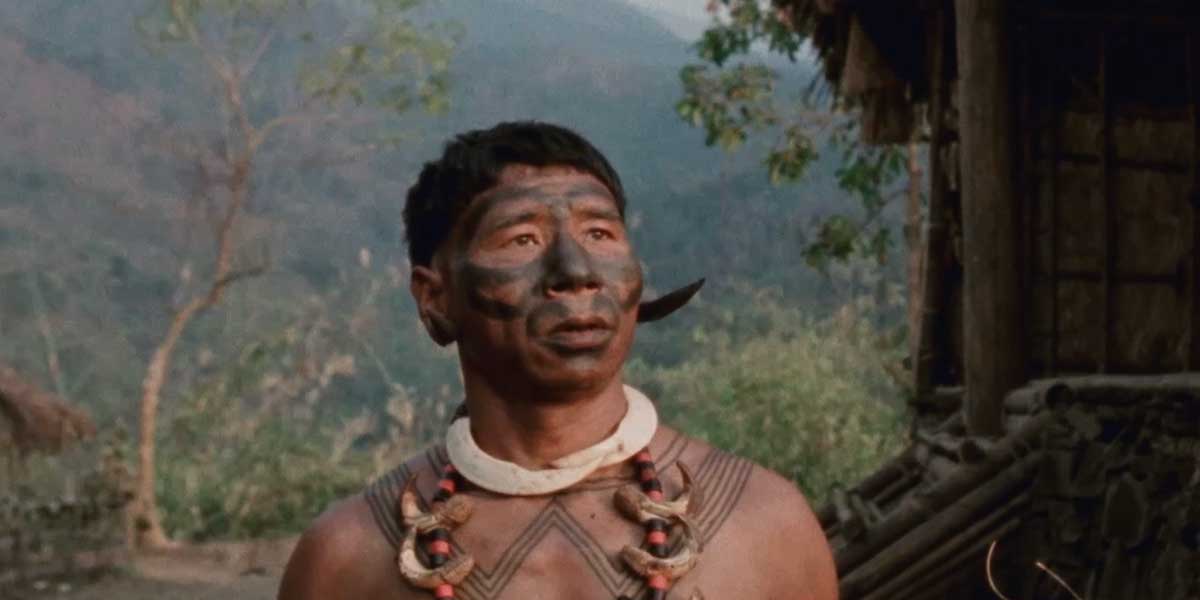
Anghba stalks his prey, controls his breathing, his arrow ready to pierce an unsuspecting wild boar. The sound of a boat cutting through the river interrupts the ritual. The arrow never flies, and the boar disappears into the jungle. An absolute premonition in this opening sequence of Angh. The first feature film by Theja Rio expands upon his 2021 short film of the same name. The director tells a story about time as an antagonist and about a slow, almost imperceptible extinction.
We are in a remote Konyak village in Nagaland, near the border between India and Burma. The 1960s are beginning, and the village is practically abandoned. Anghba is the last chief who remains, but he no longer has a village to lead; only his wife and son remain with him, the last bastions of a society that is disappearing along with them. The arrival of an American missionary delivers the final blow: if time had already been taking aim at ancient Konyak traditions, modernity is the arrow that finally finds its target.
Angh builds its discourse through silence. Cinematographer Adam Pietkiewicz achieves something unusual: making the passage of time visible in every frame. Shot on 16mm film, the texture of celluloid ceases to be merely an aesthetic choice and becomes another narrative tool, almost a character in itself. That texture blurs the line between fiction and documentary, giving the images the quality of a memory, of an era already lost. This is not a reconstruction of the 1960s, but an echo of them. This is no coincidence: Theja Rio sought to capture the essence of archival footage filmed by early American missionaries among the communities of Nagaland during the 1950s and 1960s, and that reference permeates every frame.
The idea of witnessing life itself, rather than simply representing it, is reinforced by the casting. Rio builds his film almost entirely around non-professional actors from the same Konyak communities portrayed in the film. We are not watching actors fabricate a cultural clash; we are watching people who are themselves living descendants of that history. The boundary between narrative and testimony becomes blurred once again, just as it was through the texture of the 16mm film.
Angh approaches extinction in a very particular way: there is a force imposing itself upon a culture that is ultimately crushed, yet there is no physical violence involved. It is a silent form of violence, one that gradually seeps in and erodes everything from within. It is the son allowing himself to be seduced by something new and drifting away from his father. It is the voice of a chief who is no longer relevant, calling out into the void.
Angh closes with the same silence from which it built its entire narrative, a silence that says more than any dialogue could. The arrow Anghba never managed to release now points toward him, and this time it finds its target. His premonition comes true; his fear of fading away without leaving a trace becomes reality.
But where the character fails, the film prevails. Angh is itself the trace Anghba feared he would never leave behind: a visual testament that transforms every metaphor into an act of memory and pride, proof that even if this people disappear from the screen, it does not disappear entirely.


Leave a Reply