
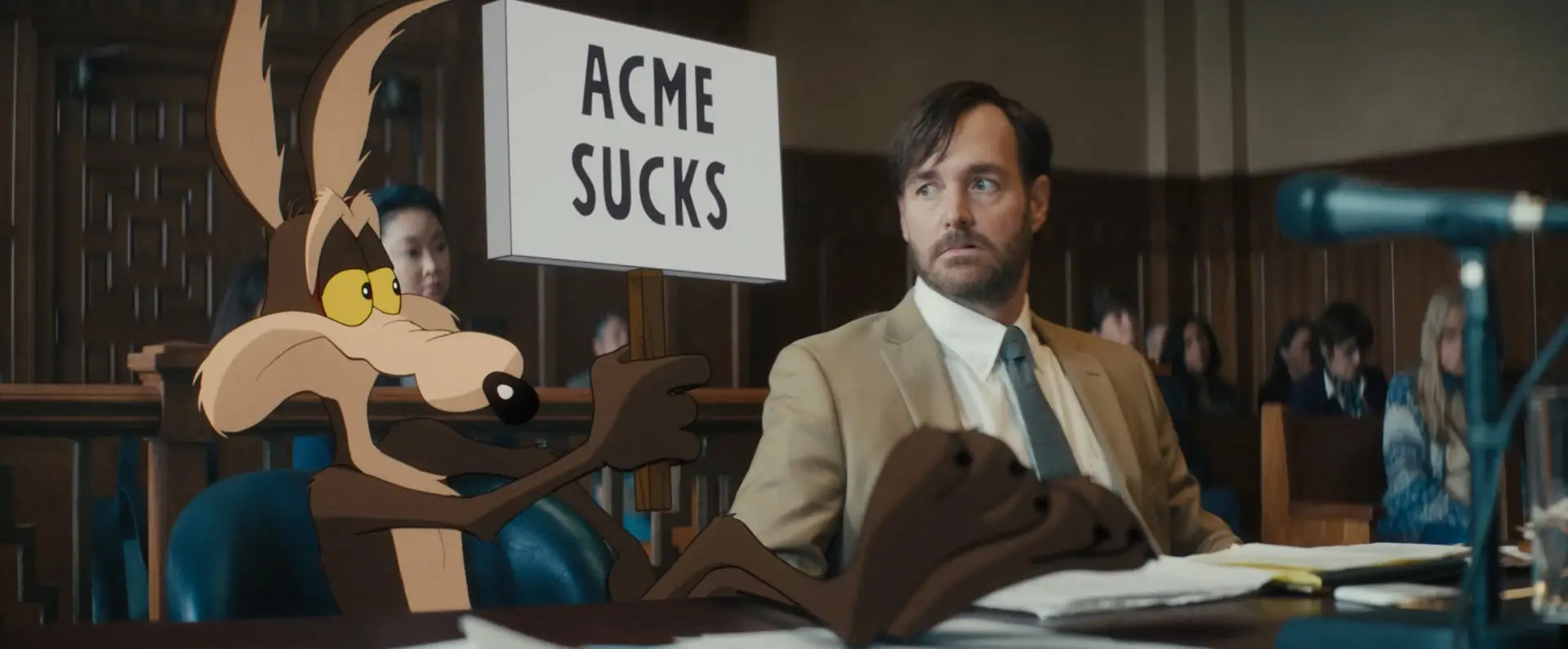
During the production of Coyote vs. Acme, no one could have imagined that the story they were telling would become a kind of epitaph. The hapless Coyote’s battle against the all-powerful Acme foreshadowed the conflict that would emerge between the film’s producers and Warner Bros. as they fought to bring the movie to theaters four years after it was completed. Beginning in 2022, Dave Green’s film became trapped in corporate limbo. Warner Bros. executives considered shelving the movie and writing it off for tax benefits rather than releasing it and trying to recoup their investment. In 2025, independent distributor Ketchup Entertainment acquired the North American distribution rights for $50 million, and in 2026 the film finally made it to theaters.
Even more astonishing is that Coyote vs. Acme arrived on the big screen just months before Warner Bros. was acquired by Paramount in one of the most controversial transactions in Hollywood history. The film’s premise ceases to be fiction and opens up an intriguing conversation, confronting us with cinema’s perennial dilemma: film as art versus film as a financial asset. It also provides a perfect illustration of the power studios wield over filmmakers’ work and the complexities of film distribution. In the movie, Wile E. Coyote takes Acme to court, accusing the company of supplying him with defective products that he has used for decades in his attempts to catch his nemesis, the Road Runner. Every Acme product fails spectacularly, preventing him from accomplishing his mission while causing him countless physical injuries.
The adventures of the Coyote and the Road Runner rank among the most legendary in animation history. Created by Chuck Jones, the duo first appeared on screen in 1949, and their impact has resonated across generations. Their visual humor and physical comedy became their trademark and a reliable source of laughter. Their effectiveness lies in the construction of absurd situations that invariably leave the Coyote biting the dust while the speedy Road Runner emerges victorious.
It is impossible to watch Dave Green’s film without thinking of Robert Zemeckis’s Who Framed Roger Rabbit (1988). The resemblance goes beyond the idea of combining animated characters with live-action performers; the narrative arc involving the Coyote and his lawyer, Kevin Avery (Will Forte), also echoes the journey undertaken by Bob Hoskins and Roger Rabbit in Zemeckis’s film. Coyote vs. Acme unfolds at a brisk pace, handles its humor with considerable effectiveness, and appeals to nostalgia without resorting to cheap emotional manipulation. The screenplay also incorporates subtle nods to films such as A Few Good Men (1992) and Chinatown (1974). At the same time, it honors the spirit of the Looney Tunes universe through its classic chase sequences, the Coyote’s silence, and the inclusion of other memorable characters whose brief appearances serve the story.
Dave Green manages to preserve the essence of a humor that has endured for generations while using it to construct a satire of power, accountability, and corporate interests. The Coyote, accustomed to getting back up after every blow and trying again, finds himself facing a different battle, but one that is just as unequal. Coyote vs. Acme ultimately becomes much more than an adventure featuring Looney Tunes characters. Its own production history lends it an unexpected dimension, transforming it into a film that seems to question the very structures that made its existence possible.



Leave a Reply