
I first discovered Fernando Eimbcke with his feature debut, Duck Season (2004), an agile, intelligent, and entertaining film that, in my opinion, ranks among the best comedies of the 21st century. Now I find myself reconnecting with the Mexican filmmaker through his latest offering, Flies. This time, the connection is different. Eimbcke shifts into a slower gear, drawing us into a drama that gradually burrows its way under our skin. We can still find traces of the sharp humor that has become his trademark, but the essence here is something else entirely. The director offers a contemplative drama that explores loneliness, grief, and human connection.
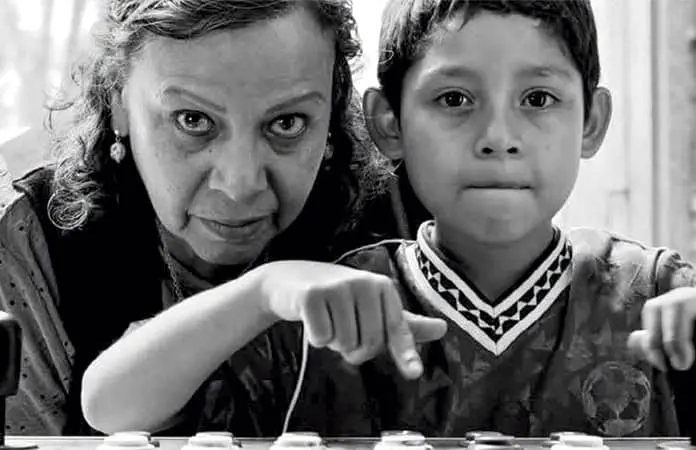
Olga (Teresita Sánchez) lives alone in her apartment, filling her days with routine and monotony. Across the street from her building stands a hospital, and patients’ families often rent rooms from nearby residents to stay close to their loved ones. An unexpected event forces Olga to rent out a room in her home, disrupting her carefully established routine. Her new tenant’s arrival brings a surprise that becomes a turning point in Olga’s life. An unlikely bond begins to emerge between Olga and Cristian (Bastian Escobar), a nine-year-old boy.
Flies is built on minimalism. Its visual approach focuses on small details, gestures, silences, and everyday situations to construct a powerful narrative. The black-and-white cinematography reinforces this sense of austerity, allowing the characters to become the film’s primary source of expressive power. Every line of dialogue arrives at just the right moment, gradually revealing essential details about Olga and Cristian and drawing us closer to them with a profound sense of empathy. Without realizing it, they share something in common, and that shared experience gradually brings them closer together.
Eimbcke uses his characters’ emotional struggles to build a complex drama about grief and absence. Each faces their circumstances differently: Olga suppresses her emotions and retreats into routine, while Cristian finds an escape in his innocence and his obsession with the video game Space Defenders. Amid this process, the director makes room for humor, not as a narrative release valve, but as an element that flows naturally within the drama unfolding around these characters.
The video game Space Defenders plays an important role in the narrative. What initially appears to be just another of Cristian’s obsessions gradually takes on a meaning that extends beyond the game itself, becoming organically woven into the relationship he begins to develop with Olga. Eimbcke handles this element with intelligence, turning it into a key part of the story and demonstrating how something seemingly ordinary can carry a much deeper emotional weight.
One of the great strengths of Eimbcke’s cinema is his ability to weave tragedy and comedy together without allowing one to overshadow the other. In Flies, he strikes that delicate balance once again, reminding us that sometimes the most unexpected connections are the ones that help us confront our own absences.


Leave a Reply