
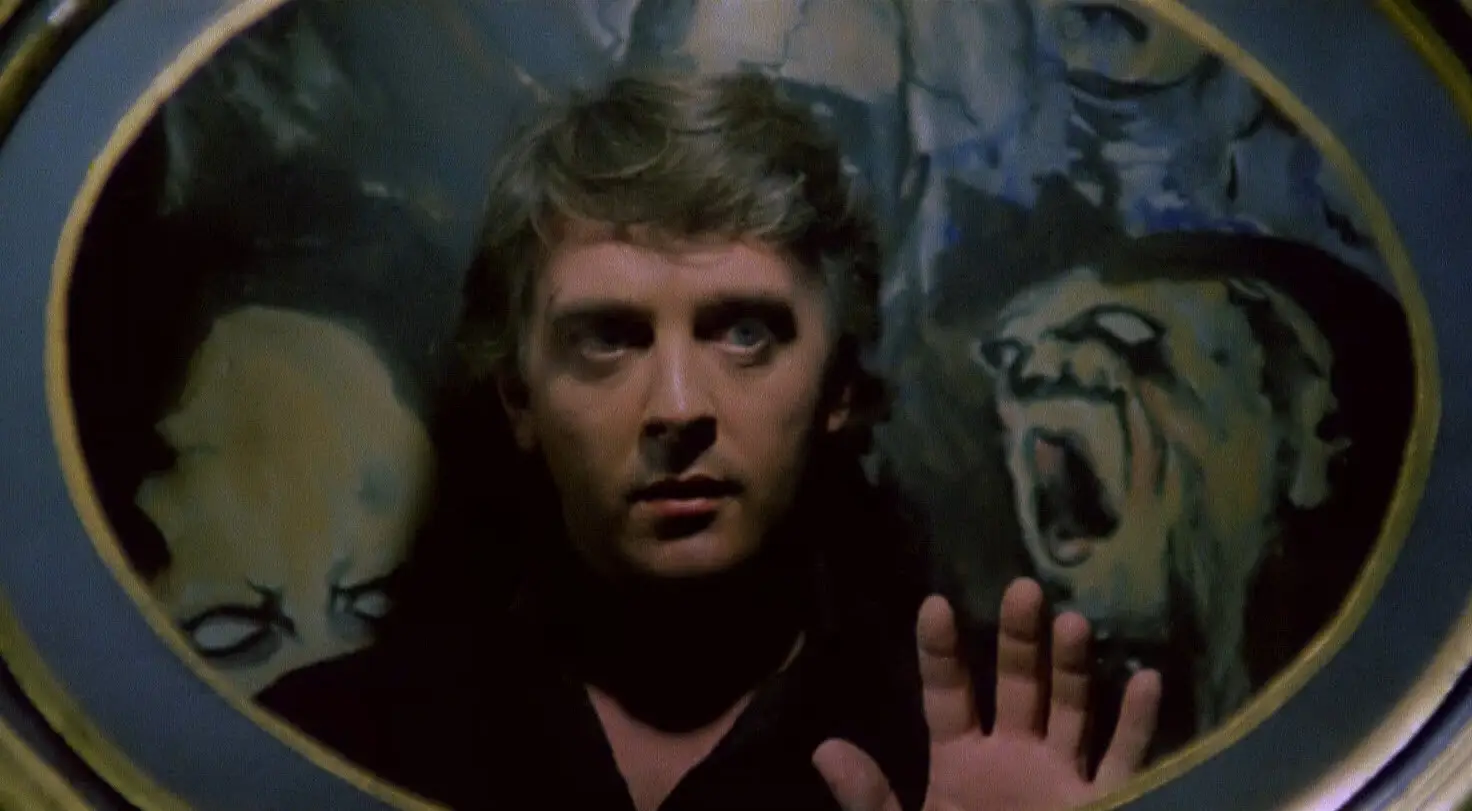
When we think of Dario Argento, we imagine a trail of blood staining the floor, a razor-sharp blade moving in time with a pair of gloved hands, and a scream cutting through the silence of the night. Deep Red is one of his most stylized works, the defining expression of his filmmaking and the quintessential giallo: a subgenre rooted in the Italian tradition of popular mystery and crime novels, combining detective investigations with horror, masked or unidentified killers, and stylized violence in which visual composition matters as much as the mystery driving the story. With this film, Argento brings the genre’s conventions to one of their most sophisticated expressions.
The story follows Marcus Daly (David Hemmings), a British pianist living in Rome who witnesses the brutal murder of a psychic and becomes embroiled in an investigation that draws him into a spiral of killings, misleading clues, and secrets buried in the past. As he attempts to reconstruct what happened alongside journalist Gianna Brezzi (Daria Nicolodi), Marcus discovers that the key to the mystery may lie in a detail he saw that night but cannot clearly remember. The screenplay works better as a device for generating suspense than as a rigorously constructed drama.
Argento throws himself wholeheartedly into the art of mise-en-scène. Every shot is composed with meticulous attention to detail, and through this process the film develops an extraordinary visual and sonic identity. Its framing, camera movements, use of color, lighting effects, and score achieve remarkable harmony. The film’s greatest strength is also its greatest weakness: Deep Red is all technique, with the director prioritizing form over narrative logic. What remains is an effective genre film in its creation of suspense, but one that stumbles when it comes to storytelling.
An essential part of Deep Red’s identity lies in its soundtrack. The opening notes of its central theme rank among the most iconic in horror cinema. The collaboration between Italian progressive rock band Goblin and jazz composer Giorgio Gaslini gives the film a distinctive sonic identity. The melody, hovering between the childlike and the sinister, heightens the suspense and creates a deeply unsettling effect. Argento transforms violence into a sensory experience, producing some of horror cinema’s most iconic images, including the film’s climactic elevator sequence.
With Deep Red, Argento consolidated the foundations of his distinctive style and helped define the giallo. The film’s echoes continue to resonate today, and its influence on generations of filmmakers is undeniable. Its technical mastery is beyond question, and its ability to build suspense is evident in nearly every shot. Yet that same obsession with form pushes narrative coherence into the background. It is a film remembered more for what it makes us feel than for what it tells us, and perhaps that is where both its greatness and its limitations lie.



Leave a Reply