
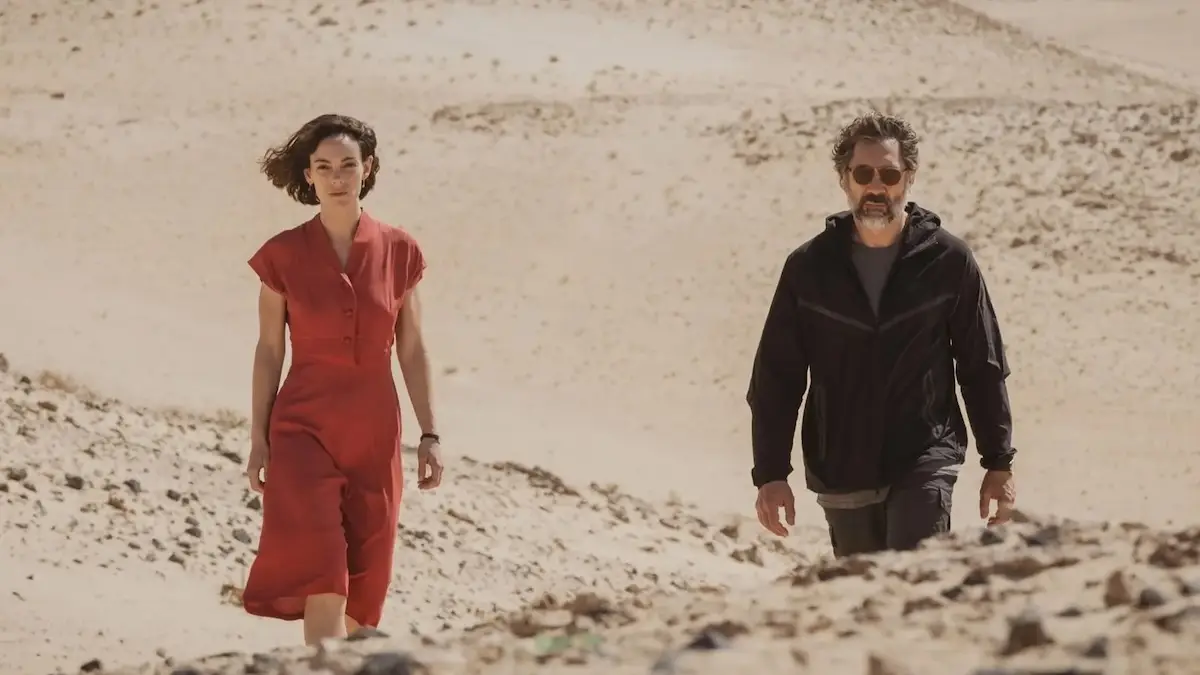

In The Beloved, the desert is the setting of the film the protagonists are shooting, but it is also a reflection of the emotional desolation that separates them. Rodrigo Sorogoyen uses metacinema to construct a family drama centered on the broken relationship between a father and his daughter: he is a successful film director; she is an actress who has not yet found her way. From that conflict, the film draws on each of their demons and creates a remarkably powerful dramatic tension.
The first time we see Esteban (Javier Bardem) and Emilia (Victoria Luengo), the camera moves into an almost suffocating close-up. Before we know their past, and even before they speak, we already feel their discomfort. They are physically close, but an emotional abyss separates them. As the conversation progresses, the situation becomes increasingly tense and uncomfortable, and Sorogoyen prepares us for what is to come. Esteban explains the reason for the unexpected meeting, and Emilia, full of doubts, accepts a proposal she never expected.
The film revolves around abandonment and wounds that time deepens rather than heals. The desert is more than an exotic setting: it becomes a mirror of Esteban and Emilia’s isolation. Esteban’s film is set in the Spanish Sahara in the 1930s and deals with Spain’s abandonment of the territory, creating a direct parallel with the relationship between father and daughter. Once we enter the troubled production, we see a despotic director obsessed with control. From his daughter’s perspective, now the leading actress in the film, he is also a manipulative father trying to impose his own version of the history they share.
Bardem and Luengo deliver outstanding performances and give the film much of its strength. Their characters invite a deeper analysis: a daughter shaped by abandonment, a father unable to find redemption, and the passage of time as a force that slowly erodes everything. The cinematography by Alejandro de Pablo, a frequent collaborator of Sorogoyen’s, is exceptional, with every frame carefully composed. Olivier Arson’s score, also created by one of Sorogoyen’s longtime collaborators, reinforces the narrative and effectively accompanies the characters’ emotions.
With The Beloved, Rodrigo Sorogoyen confirms that he is one of the most daring filmmakers working today. He starts with a family drama and transforms it into a story of relentless intensity, infused with the tension of a thriller. His use of metacinema works because it never feels like a mere trick: the production in the desert becomes a way of revealing what father and daughter cannot say to each other directly. At times, the film is uncomfortable, but that discomfort is part of its strength. Once again, Sorogoyen demonstrates his ability to extract gripping tension from the intimacy of a family and sustain it all the way to the end.


Leave a Reply