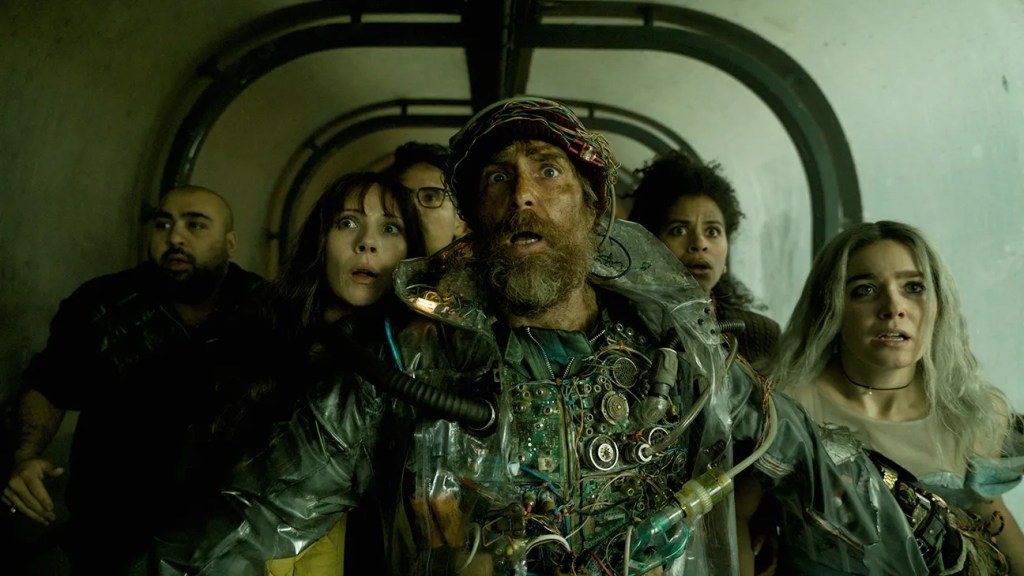
If we mix Terminator 2 (1991) with Groundhog Day (1993) and 12 Monkeys (1995), the result would surely be something like Good Luck, Have Fun, Don’t Die (2025). Director Gore Verbinski borrows the Terminator’s mission, the time-loop repetition of Groundhog Day, and the fatalism of 12 Monkeys to craft a sharp satire with a voice of its own. The peculiarity suggested by the title feels like a warning to the viewer who dares to venture into this film. Verbinski opts for a discourse that unsettles, both because of the truths it exposes and the way it delivers them.
In the opening sequence, we see a man (Sam Rockwell), dressed like a vagrant, enter a restaurant and begin disturbing the diners with a prolonged monologue about the end of the world and a recruitment campaign for warriors to fight a powerful artificial intelligence entity. From that moment on, the script of Good Luck, Have Fun, Don’t Die begins to unfold its social critique. A macabre sense of dark humor is the main tool used by screenwriter Matthew Robinson (Live Die Repeat and Repeat): the end of the world is imminent, and we are all accomplices, whether by association or by omission.
That man from the future, portrayed by Sam Rockwell, is the inner voice we refuse to listen to. Harsh, rude, irreverent, yet painfully accurate. Through this character, Verbinski reproaches us and forces us to question the current world and the dominant role technology plays in our lives. The villain is not an intimidating monster breathing fire; it is subtle and friendly, seductive and ensnaring. Good Luck, Have Fun, Don’t Die gains additional strength thanks to the parallel stories of its group of protagonists; through flashbacks, the director gives weight to their narrative arcs and enriches the story.
Between action, time travel, and tragic sarcasm, Good Luck, Have Fun, Don’t Die moves forward at the pace of its protagonists and their epic mission to confront and provoke us. Within the fiction, we can recognize the dark reality of our present: social disconnection, extreme violence, and the use of technology devoid of ethical purpose. It seems that Verbinski uses dark humor as a cry of resistance, resulting in a film that feels both timely and necessary. The end of the world works as a double allegory: on one hand, the struggle of cinema against artificial intelligence, and on the other, humanity facing the monster it created itself.
 The Last Movie Guy