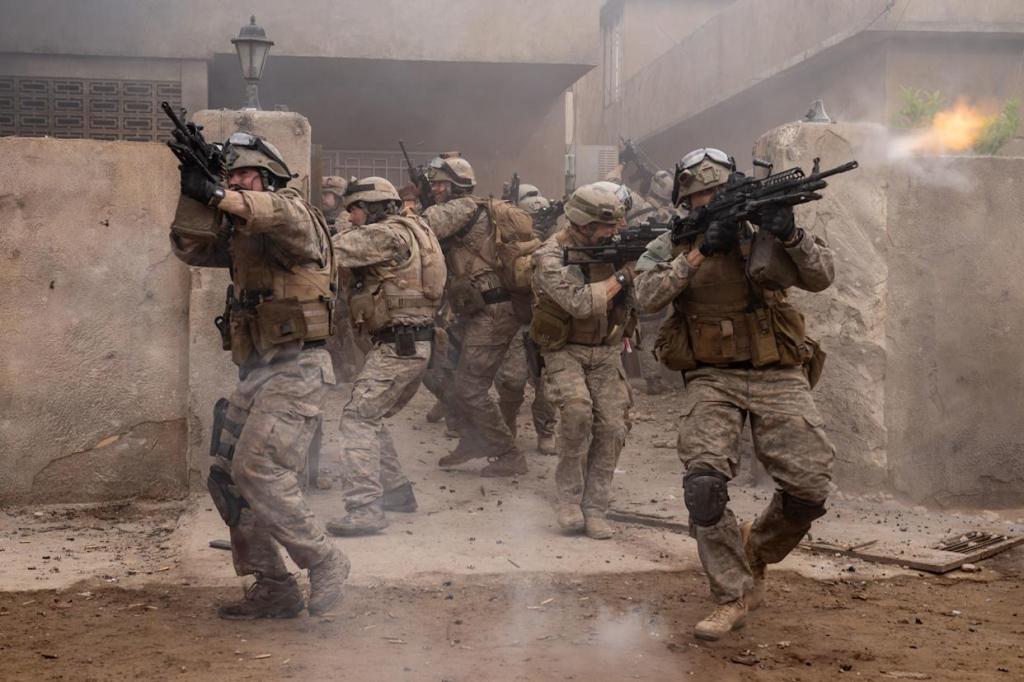
War has always been fertile ground for cinema. Warfare (2025), by Ray Mendoza and Alex Garland, ventures into these paths by telling a specific incident during the Second Battle of Ramadi in 2006. American forces were fighting for control of this key city in central Iraq. But Warfare does not aim to be an action film or a thriller that leans on real events to take the audience on a rollercoaster of visual effects and endless gunfights—no. Warfare seeks to be a testimony, a kind of tribute, and a recounting based purely on memory.
The Navy SEAL squad Alpha One is tasked with supporting operations in the city of Ramadi, and to do so, they take control of a two-story civilian residence that allows them to monitor a neighborhood with suspicious activity. What seemed like a simple and short mission turns into a true hell when the team is discovered and attacked. Once Alpha One’s position is compromised, they become trapped in that house.
The Battle of Ramadi
Warfare is born primarily from the memories of Ray Mendoza. He personally lived through this failed mission. Now Mendoza takes the director’s chair, alongside veteran Alex Garland (Civil War, Ex Machina). Mendoza had already worked as a consultant for several war films and felt it was time to step behind the camera to talk about the Iraq War—a topic that, for him, has not received much attention in cinema. But the main objective was to pay tribute to his squad-mate Elliot Miller, played by Cosmo Jarvis.
Contrary to the norm in war films, Warfare is a slow burn. The film demands that the audience immerse themselves and feel the tedium and uncertainty that weighed on Ray (D’Pharaoh Woon-A-Tai), Erik (Will Poulter), Sam (Joseph Quinn), Elliot (Cosmo Jarvis), and the other members of Alpha One. Suspense is what carries the film from beginning to end—at first driven by the unsettling nature of the situation, and later maintained through despair, fear, and horror.
Blood and Pain
Similar to what films like Jarhead (2005), The Hurt Locker (2008), and American Sniper (2014) achieve, this Warfare connects us on a deeper level with the protagonists. While the others rely heavily on drama and fiction to sell their story, this one leans more on raw and simple facts, showing an unflinching reality that cannot be ignored. David J. Thompson’s cinematography and Fin Oates’ editing take us through a real-time chronology of that failed mission. From the opening title to the devastating final sequence, the time on screen matches exactly the time Ray and his team spent in that battle in Ramadi.
Warfare has no soundtrack. All sound design focuses on the real sounds of the battlefield. Except for the song in the opening sequence and another during the closing credits, there is no music accompanying the images, making the storytelling more effective. Like the calm before a storm, this builds the path toward Warfare’s climax. The tension grows and then explodes (literally), leaving us stunned—we knew the moment was coming, but the impact is so brutal it shakes us to the core.
Ray Mendoza and Alex Garland have created a film that will surely be referenced for years to come when discussing war in cinema. Its abrupt and hopeless ending reminds us that in war, there are no winners. Only blood and pain.
 The Last Movie Guy