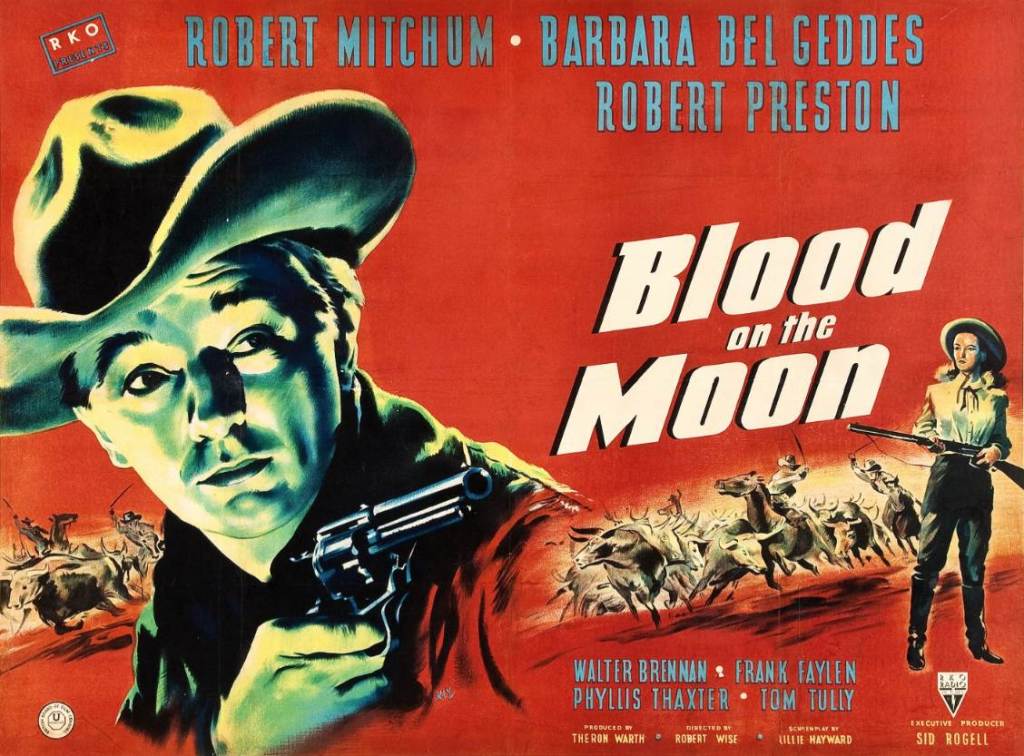
Before making Blood on the Moon (1948), Robert Wise had already established himself as a prestigious director in the Hollywood industry. What few know is that it was Orson Welles who gave him the opportunity that would change his life. Wise began working in RKO’s accounting department but soon ended up working as an assistant director. When Welles embarked on producing his legendary Citizen Kane (1941), he sought Wise to edit the film. After the impressive work editing Welles’ masterful work, Wise’s career took off.
The novel Gunman’s Chance by Luke Short was always in Robert Wise’s sights to be turned into a film and it was under the pen of Lillie Hayward and Harold Shumate that the script came to life to become Blood on the Moon. Wise had presented the project to RKO but rather as a producer and with Jacques Tourneur as director. Tourneur passed on from the project and that’s how Wise ended up in the director’s chair. The story of the wandering gunslinger who ends up in the middle of a power struggle in a distant western town was nothing new for the Western genre. The turn towards the realms of film-noir made the film starring Robert Mitchum separate itself from the rest.
A Pure Noir in the West
The script follows a series of characters full of ambivalence. Robert Mitchum’s Jim Garry leads the troop. Without knowing what awaits him, he responds to the call of his friend Tate Riling (Robert Preston), who is in a territorial fight with the landowner John Lufton (Tom Tully), things get complicated when Lufton’s daughters, Amy (Barbara Bel Geddes), and Carol (Phyllis Thaxter) come into the scene. In the introduction the story takes the direction of the traditional Western, checking all the boxes regarding the description of the characters and establishing the framework under which the plot develops. When we reach the second act, the narrative becomes more complex and delves into the psychological profile of the characters, the fights and challenges are maximized by the moral dilemmas that arise.
Wise’s excellent direction is combined with the cinematography work of Nicholas Musuraca (Out of the Past, Cat People). Giving that touch of film noir in the visual aspect of Blood on the Moon is one of the highest points of the film. For Musuraca it was sailing in its waters since it was something he had already done before. Here he uses chiaroscuro to perfectly set the interior sequences and highlight the expressions of the characters. Similarly, Wise and Musuraca experimented with infrared films for the night sequences.
Blood on the Moon was one of those first Westerns that ventured into the waters of film noir and did so successfully. A solid story with good turning points and characters that represent very well both the codes of the classic Western and the archetypes of those film noir figures.
 The Last Movie Guy