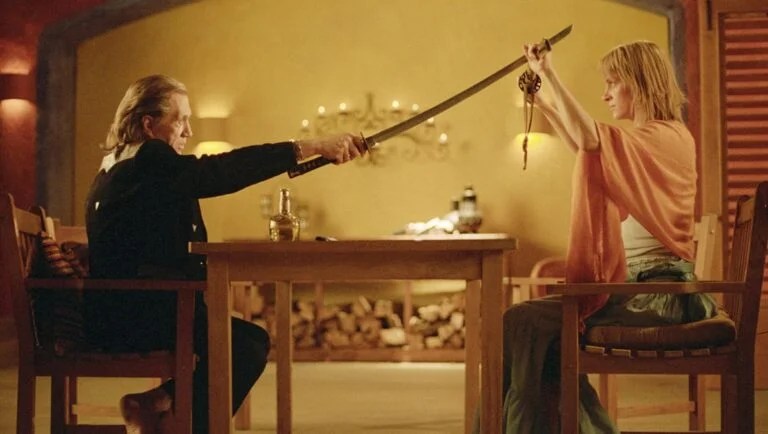
Kill Bill was love at first sight, quite literally. When Quentin Tarantino delivered his fourth feature film in 2003, the cinematic world was shaken. Hollywood’s l’enfant terrible did it again, this time with an epic revenge tale that had to be split in two to ensure effective commercial distribution. In 2004, Volume 2 arrived, confirming that we were witnessing one of the finest films of the 21st century.
With Kill Bill: The Whole Bloody Affair, Tarantino finally fulfills his dream of presenting the film in the format in which it was originally conceived: a 4-hour-and-35-minute marathon featuring previously unseen material and an extended animated sequence that delves deeper into the past of O-Ren Ishii (Lucy Liu). Caprice or not, QT’s move has only served to reaffirm that Kill Bill is a perfect film. Time—perhaps the most severe of judges—has failed to leave even the slightest mark on it. Every shot, every sequence, every character, every line of dialogue retains the same power, perhaps even more so, now that more than 20 years have passed since its debut on the big screen.
In Tarantino’s universe, characters are everything. His stories are born from figures who may seem simple at first glance but reveal themselves to be deeply complex upon closer inspection. Kill Bill is no exception—on the contrary, it is the clearest example of how his films are built from character. Actions, situations, and every single scene exist because of these protagonists. It is not a series of impeccably crafted action set pieces that introduce us to The Bride (Uma Thurman) on her quest for revenge; it is The Bride herself and her motivations that guide us through this blood-soaked journey of retribution.
The Art of Vengeance
Kill Bill: The Whole Bloody Affair offers a glimpse into the mind of a genius. Structuring a film that blends so many cinematic influences without any of them feeling excessive or out of place is a titanic task. Spaghetti westerns, samurai cinema, 1970s exploitation films, anime, drama, action, and comedy all converge in perfect balance. It is hard to imagine any director other than Tarantino capable of combining so many styles with such force. Nothing here is gratuitous or merely decorative; every reference serves the script. Even as he indulges in his obsessions and homages, he reinvents every frame to create a universe entirely his own. He steals from everyone and everything to transcend genres and eras.
We are in the presence of one of the greatest revenge stories ever put on film. In terms of mise-en-scène, it is utterly captivating. Robert Richardson’s camera becomes a protagonist in itself, with every shot dancing to the rhythm of the music composed by RZA and Robert Rodriguez. The cherry on top is the editing by Tarantino’s longtime collaborator, Sally Menke. From Reservoir Dogs (1992) onward, Menke was responsible for editing all of Tarantino’s films; she was the one who shaped and gave rhythm to the Tarantino universe.
Kill Bill: The Whole Bloody Affair is an overwhelming cinematic experience. It stands as the ultimate paradigm of revenge stories, rising above violence used as mere spectacle to transform vengeance into poetry, achieving a perfect balance between the visceral and the emotional. It is an intimate process in which a director turns his obsession into art.
 The Last Movie Guy