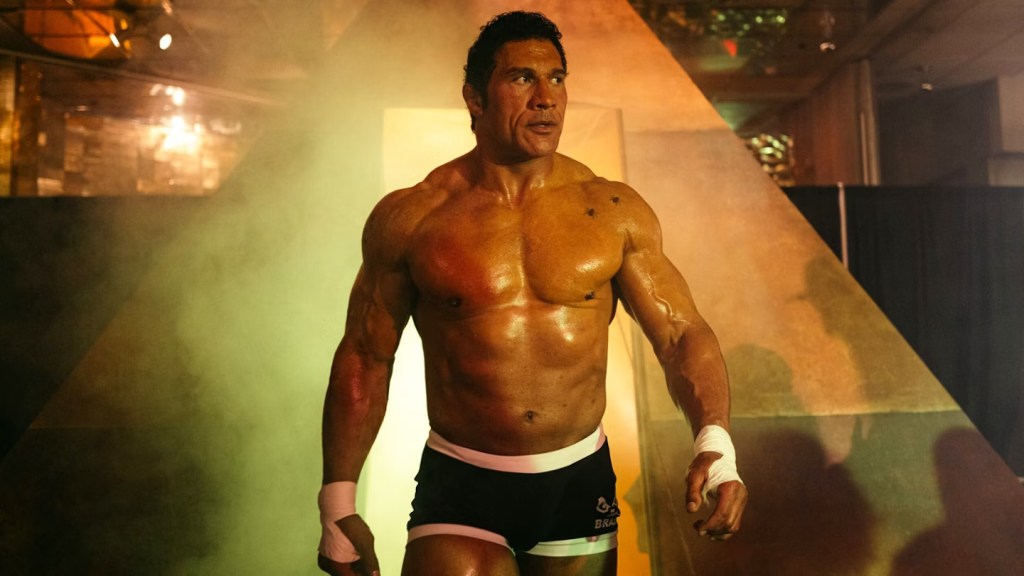
There is a striking contrast between the Mark Kerr we see crushing opponents inside the ring and the smiling, distracted Mark Kerr riding a carousel like a child. That powerful juxtaposition reveals the complexity of the inner battle Kerr fights. The Smashing Machine (2025), directed by Benny Safdie, explores a fragment of the life of one of the pioneers of Mixed Martial Arts (MMA) — his meteoric rise and brutal downfall. With an almost documentary tone, Safdie exposes the humanity of a figure who is both sweet and bitter, inspiring and tragic.
Far from the glory and excitement that usually accompany sports dramas, The Smashing Machine paints a more sober and intimate portrait. Safdie observes Mark Kerr with a mix of reverence and fascination, and what he brings to the screen is a deeply human drama. The story begins at the precise moment when the legend is born, laying the foundation as it delves into Kerr’s turbulent relationship with his girlfriend Dawn Staples, his opioid addiction, and the physical and psychological toll of a sport that was almost without rules in its early days.
Dwayne Johnson’s Metamorphosis
Just as Mark Kerr feels the weight of the world on his shoulders, so too does Dwayne Johnson’s performance carry the full weight of The Smashing Machine. What Safdie demands of him—with a script that necessarily revolves around his ability to bring the central character to life—is immense, and Johnson delivers a performance that shatters every stereotype his acting career has built. It’s not just the physical transformation achieved with the help of the makeup team; what’s most striking is the emotional depth he brings to the screen. His silences are as powerful as the punches he throws at his opponents. That imposing figure becomes fragile, collapsing under the emotional void and the inability to accept failure.
With Emily Blunt as Dawn Staples, the director completes the emotional equation of the film. Blunt serves as the catalyst for a performance that both balances and enhances Johnson’s, with brief yet intense moments in which she takes complete control of the scene. Always effective, Blunt maximizes every second on screen with a restrained power that overwhelms. The connection between Dwayne Johnson and Emily Blunt is vital to The Smashing Machine’s success. Still, it’s also worth highlighting Johnson’s dynamic with Ryan Bader, who authentically embodies Kerr’s endearing friend and fellow fighter, Mark Coleman.
The Smashing Machine Universe
What distinguishes Benny Safdie’s filmography is his meticulous attention to detail and the execution of every aspect. On an audiovisual level, he always delivers hypnotic experiences, and The Smashing Machine is no exception. Maceo Bishop’s camera gives the film an almost documentary texture and shines both in the combat sequences—whether in the physical battles inside the ring or the emotional confrontations within Mark and Dawn’s home—and in moments of silent vulnerability. Nala Sinephro’s melancholic jazz-infused score fills each frame with an introspective rhythm that guides the pulse of the editing. Image and sound come together perfectly to elevate the film beyond the sports drama; this is a profound reflection on a man and on human fragility itself.
In Dwayne Johnson’s hands, Mark Kerr ceases to be a mythical figure and becomes a mirror of the human condition — a giant with feet of clay who sinks deeper with every blow he delivers and every victory he achieves. The Smashing Machine not only reconstructs the rise and fall of an MMA legend; it is a drama that examines, with surgical precision, the deepest corners of the soul.
 The Last Movie Guy