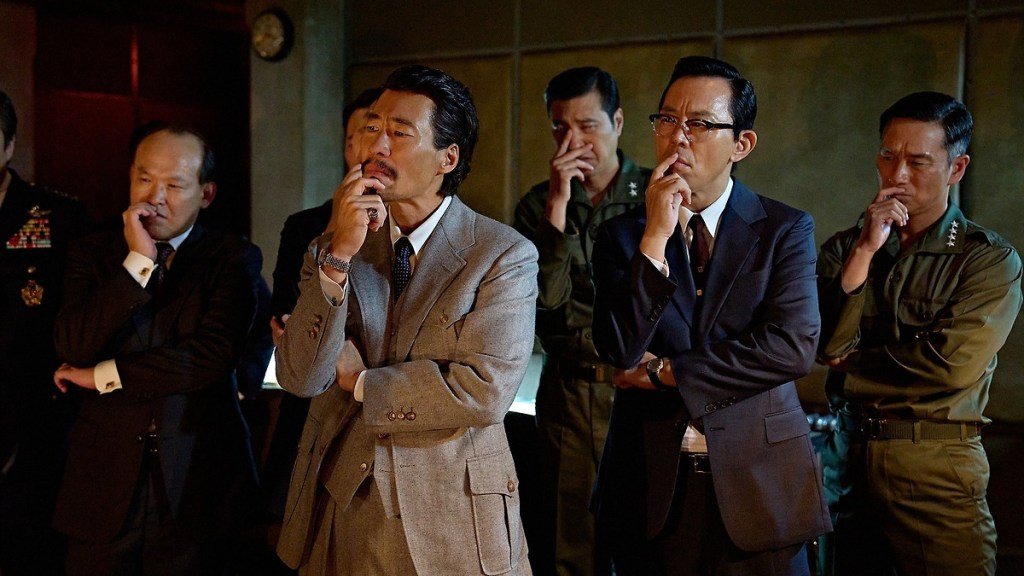
In March 1970, nine members of the radical group Japanese Communist League-Red Army Faction hijacked a plane at Tokyo International Airport. Good News (2025) by Byun Sung-hyun draws inspiration from this event to craft a portrait of the happenings through political satire and dark humor. The South Korean director delivers a visually striking film with a brisk pace, achieving an excellent balance between comedy and suspense.
In Good News, there are neither good nor bad characters. There are opportunists, inept individuals, and the naïve. From opportunism and ineptitude emerges the antagonist, while from naïveté comes the hero. In the shadows, we have the antihero who, like Sanjuro in Yojimbo (1961), aligns with one side and then the other to achieve a higher good beyond personal interests. The script focuses on the hijackers and their demands, contrasting their actions with those responsible for resolving the situation. From this confrontation, the director delivers a sharp political critique.
The Yodogo Incident
The hijacking of Japan Airlines Flight 351, later known as the Yodogo Incident, revealed the lack of preparedness of both the Japanese and South Korean governments in dealing with terrorism. Good News finds its strongest point in the clever, though risky, maneuver by the South Korean government: attempting to deceive the hijackers, who demanded to fly to Pyongyang, North Korea. The strategy involved making Gimpo Airport in Seoul appear to be the North Korean capital’s airport. Precise editing, time jumps, and the interplay of humor and suspense allow the director to turn this part of the conflict into the anchor of the entire narrative.
Good News shines not only for its flawless execution and mastery of cinematic language but also for the performances of a cast that operates like a perfectly synchronized machine. Sul Kyung-gu leads with his portrayal of Nobody, a character who reminds us that sometimes even the truth can lie. In the Machiavellian chess game he orchestrates, the director inevitably evokes classics like Dr. Strangelove (1964), where the absurdity of irrational leaders translates into figures running back and forth like headless chickens.
We can view Good News as a biting satire on power, manipulation, and the fragility of political systems. The film transcends mere recreation of a historical event, and Byun Sung-hyun’s sarcastic perspective makes us laugh while also feeling uneasy. Its ending, with an almost poetic tone, is the cherry on top.
 The Last Movie Guy