Mother Nature has spoken and says she needs the sacrifice of three people to restore order and prevent total collapse. Sacrifice (2025) by Romain Gavras relies on satire to present its discourse loaded with social and political critique. After gifting us the frantic Athena (2022), Gavras now delivers a more restrained and contemplative proposal. The French director exchanges fury for reflection without losing his critical gaze toward contemporary society.
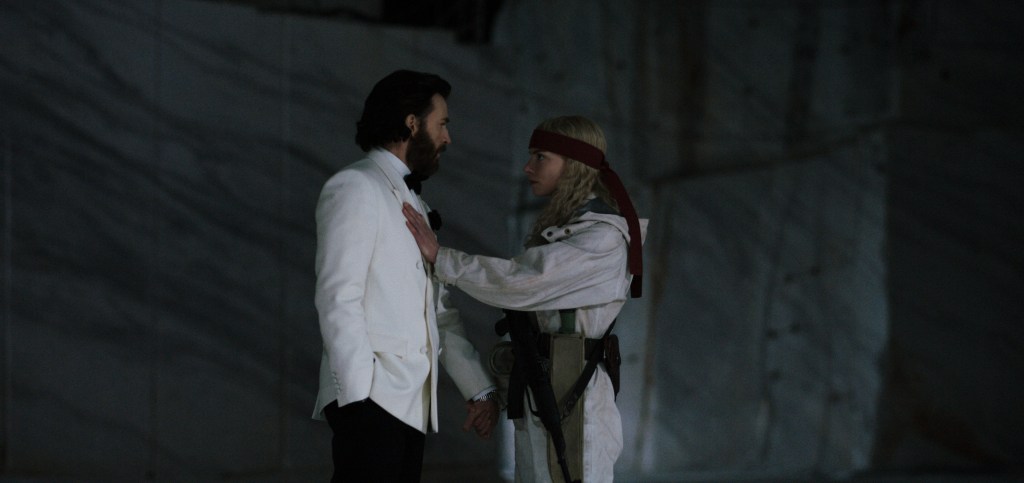
At a charity gala, several celebrities and high-society figures gather. Among the attendees is Mike Tyler (Chris Evans), an actor trying to revive his career and win back the public’s favor. The evening is abruptly interrupted by Joan (Anya Taylor-Joy), the radical leader of an extremist environmental group. This is the starting point of Sacrifice, which begins to distill its incisive satire. In just those first few minutes, it cleverly condenses one of the most pressing dilemmas of our time.
Sacrifice or Die
We can divide the film into two major acts. In its first part, the director lays out his discourse and the questions that arise from the central conflict. The audience is forced to confront the existential dilemmas born from Joan’s absurd actions. Through irrationality, she pushes us to question problems that have no easy solutions. In Sacrifice, self-immolation is not just an allegorical ritual—it is a mirror of the incoherence in the modern world of those who engage in environmental struggles. In its second act, the film slows down a bit and loses the momentum with which it began. Gavras pulls us out of the intellectual battle and brings the conflict into the physical realm, where he examines another side of the folly of those who want to save Mother Earth.
It is fascinating to see Chris Evans parody himself with irony, moving away from his superhero aura to embody a worn-out actor trapped in the midst of an existential crisis. For her part, Anya Taylor-Joy has no trouble playing the volatile and eccentric eco-terrorist. Her intensity sustains much of the story. Sacrifice relies heavily on these performances, which bring the director’s political discourse to life.
With Sacrifice, Romain Gavras achieves a provocative work that, through satire, challenges the viewer and places them in an uncomfortable position to reflect on the sociopolitical dynamics of today’s world, which lives under the constant threat of total collapse. From that dark fable, the film exposes with rawness the inconsistency of environmentalist rhetoric and social hypocrisy. Gavras does not provide certainties, but rather a narrative loaded with urgent questions.
 The Last Movie Guy