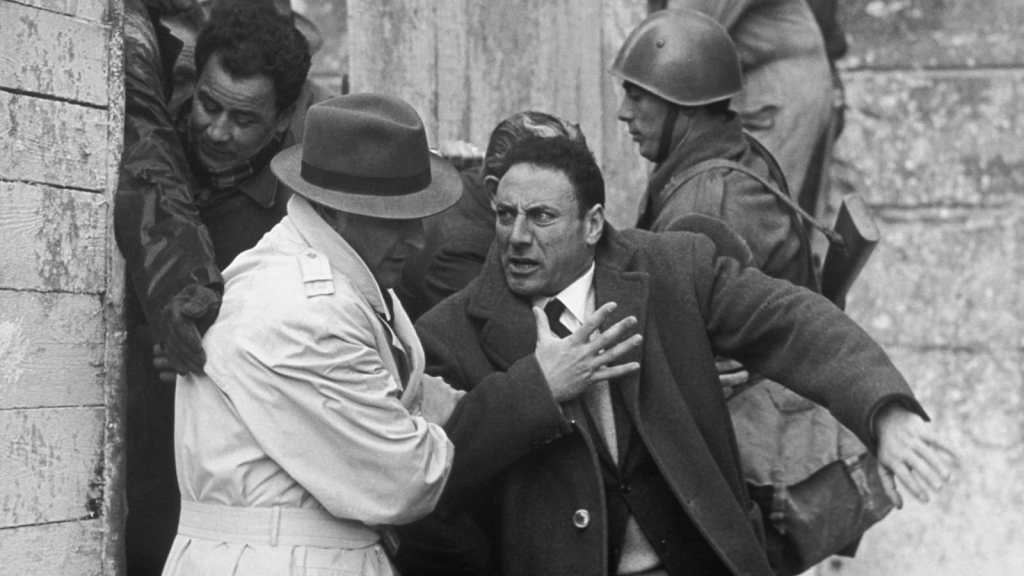
Few films achieve the narrative force that Francesco Rosi accomplishes in Hands Over the City (1963). In Venice, it would win the Golden Lion, and in Italian cinema, it would mark a turning point within the Neorealism movement. The film maintains the essence of Neorealism with its settings in real locations and its commitment to social reality, but it opens a new avenue with a more political, analytical discourse, committed to denouncing power structures. This would become Rosi’s trademark.
In Hands Over the City, Francesco Rosi unmasks the hidden mechanisms of political power through the figure of Edoardo Nottola (Rod Steiger), an unscrupulous builder who, from his seat on the Naples city council, manipulates urban decisions for his own benefit. The collapse of a building acts as the trigger for an investigation that reveals the institutional rot behind urban growth. With a precise gaze and an almost documentary-like mise-en-scène, Rosi constructs an implacable portrait of corruption as a system.
From the opening credits, we feel the omnipotent force that envelops the city of Naples. The camera glides over its streets to the rhythm of Piero Piccioni’s powerful score. From above, everything looks small; those houses and buildings seem like pieces that invisible hands move at will. These same ambitious edifices end up relentlessly displacing the most vulnerable. From here begins Rosi’s denunciation, reflecting the abuses committed in post-war Italy when reconstruction became a source of corruption.
Rod Steiger, in the role of Edoardo Nottola, delivers a restrained yet powerful performance, full of cynicism and ambition. Although he was dubbed into Italian, his physical presence and body language are enough to convey the coldness of a man who moves with ease in the corridors of power. Rosi films him with surgical precision, moving away from dramatic excesses and opting for a sober mise-en-scène. The direction avoids artifice and goes straight to the point, and the editing — by Mario Serandrei — articulates the political tension with a firm rhythm that never loses its pulse or clarity. Every shot seems studied to reveal not only what is seen but what is hidden behind official discourses and decisions.
Hands Over the City is a film that transcends cinema; although it was not completely censored, it did encounter institutional resistance in Italy from the authorities to minimize its social and political impact. It is a perfect example of how cinema can be a tool for critique against power and a work that still holds great historical value.
 The Last Movie Guy