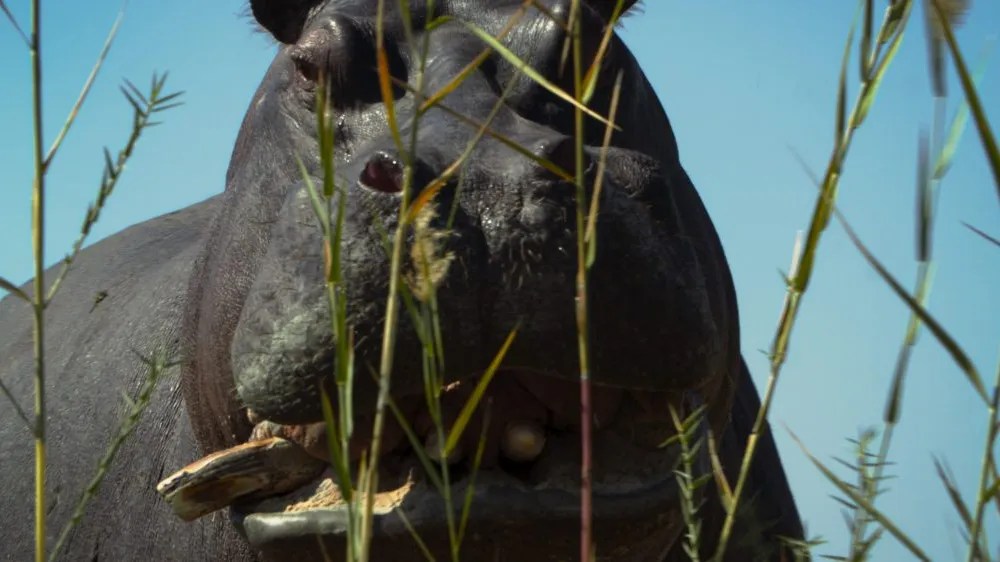
Like Joe Gillis floating inertly in that pool of a luxurious mansion on Sunset Boulevard, Pepe’s voice tells us about his disastrous destiny from the beyond. The new proposal by Dominican director Nelson Carlo de Los Santos Arias won the Silver Bear awarded to Best Director at the prestigious Berlin Film Festival. If the award at the Berlinale is a milestone, the film conceived by Nelson Carlo is even more surprising. We are facing a work that surprises us. Its narrative invites us to think from the auditory point of view, it is a constant challenge. The meditations of that hippopotamus are the common thread of a journey that explores themes that cross the anthropological and take us to existentialism. The origin of life, migration, and colonization, are just some of the theses that emerge from Pepe.
With its persistent overhead shots, the film takes us away from the mainland and brings us to a point where we see many universes in the bed of a river. But before reaching the waters of the Magdalena, our omnipresent protagonist must make an involuntary journey that tears him from hisoriginates roots and plants him in a new world. In contrast to Pepe’s exodus, we have those lives that know no other environment than that of the banks of the Magdalena, planted there forever and constantly shaken by external forces.
Pepe the thinker
Pepe’s story originates with Pablo Escobar. More than 30 years after the death of the infamous drug trafficker, his impact still lasts even in the most unexpected ways. Reading about a traffic accident involving a hippopotamus on a highway in Colombia sounds bizarre. Still, it is as real as Hacienda Nápoles and the reign of terror that Escobar led. What started with four hippos has today become a problem. Currently, it is estimated that the population exceeds 130 specimens. They have unbalanced Colombia’s ecosystem and are a threat to the inhabitants.
Nelson Carlo’s speech in Pepe is sharp and profound but the narrative is charged with a tense humor that borders on cynicism. The camera stands and observes, and the viewer becomes a voyeur and accomplice. Either when we look at a shot in total darkness, we know that there is a vehicle in motion and suddenly the streetlights allow us to see the face of a soldier. Or when we watch the Peter Potamus cartoons on an old television and the images are accentuated by the lights of the cars that hit and go. What Pepe achieves on a visual level is spectacular, in the same way, his sound universe, which is commanded by the voice-over of our unusual protagonist, is impressive.
With its symbolism, philosophical thoughts, and its evocation of the circular nature of life and its hustle and bustle, Pepe is presented as a film that forces discussion on multiple levels and that is impossible to classify.
 The Last Movie Guy