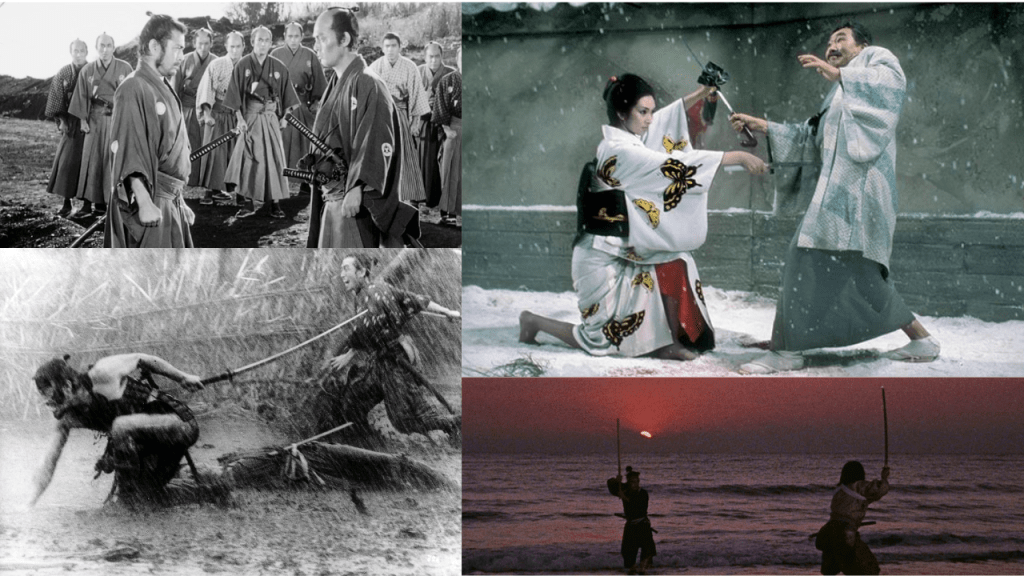
Let’s explore the Samurai Figure in the history of cinema through 7 essential films.
The Seven Samurai (1954)
It is impossible to approach the samurai film genre without mentioning the master Akira Kurosawa. The Seven Samurai is one of the most important films in the history of cinema and one of the most influential. The Japanese director’s work is full of these legendary warriors. In The Seven Samurai, Kurosawa’s mastery is manifested in each composition and in each of the battle sequences; this was the first film in which the director used multiple cameras.
Toshiro Mifune, with whom Kurosawa worked in a total of 16 films, heads a fabulous cast that allows the viewer to make an in-depth analysis of each of the characters.
The Samurai Trilogy (1954-1956)
Musashi Miyamoto (1954), Duel at Ichijoji Temple (1955) and Duel on Ganryu Island (1956). They collect an epic adventure inspired by the life of the legendary samurai Musashi Miyamoto. Director Hiroshi Inagaki recruited Toshiro Mifuene to play the legendary Musashi and in the process created Toho studio’s second most expensive film at that time. Only Kurosawa’s Seven Samurai surpassed it in production costs.
The samurai trilogy is based on the famous novel Musashi by Eiji Yoshikawa and in addition to telling the story of the mythical samurai, it is also a historical account of 17th century Japan. It is mandatory to see the work as a whole and not each film as a separate piece.
Sanjuro (1962)
Sajnuro is the sequel to Yojimbo (1961). Once again Toshiro Mifune and Kurosawa make a duo and of course they do not disappoint. The ronin played by Mifune arrives in a new town where he helps a young man save his uncle who has been unjustly imprisoned.
The idea of the samurai who wanders aimlessly is developed once again now under the pretext of criticizing the sterility of violence. Magnificent staging by Kurosawa and a brilliant performance by Mifune.
Harakiri (1962)
Director Masaki Kobayashi tells the story of a young ronin who is forced to commit suicide for his honor and duty. The nefarious ritual of harakiri is what dictates the tone of this slow-burning drama that shakes us with moments of extreme violence.
One of the greatest strengths of this film is the high artistic level in its production design and the atmosphere that the director manages to create with the editing and the soundtrack.
Lady Snowblood (1973)
One of the least talked about films in the samurai genre is director Toshiya Fujita’s revenge adventure. Meiko Kaji plays an angel-faced assassin who seeks revenge against those responsible for raping her mother. This character served as inspiration for the creation of O-Ren Ishii in Quentin Tarantino’s film Kill Bill. Tarantino also took the central theme to add it to the soundtrack of his Kill Bill.
Wonderful use of color to frame a story full of violence that is told with a poetic but heartbreaking tone.
Shogun Assassin (1980)
Director Robert Huston introduced Western audiences to the character of Itto Ogami, a samurai who is wrongly accused of treason and forced to live as an outlaw with his son. The creation of Kazuo Koike became one of the classics of manga and was brought to the big screen in the 70s before this version was made intended for audiences outside of Japan.
Shogun Assassin gained cult status thanks to VHS and its heavy load of graphic violence. Today it is one of the essential pieces when we talk about samurai cinema.
Twilight Samurai (2002)
Yoji Yamada can be considered responsible for reviving samurai films. This became the first of a trilogy that was completed with The Hidden Sword (2004) and Love and Honor (2006). Yamada presents us with a more human side of the warrior who must confront the end of an era with family difficulties.
The film has formidable performances and spectacular photography. At the Japanese Film Academy Awards, the film won 12 statuettes, including Best Film, Best Director, and Best Screenplay.
 The Last Movie Guy