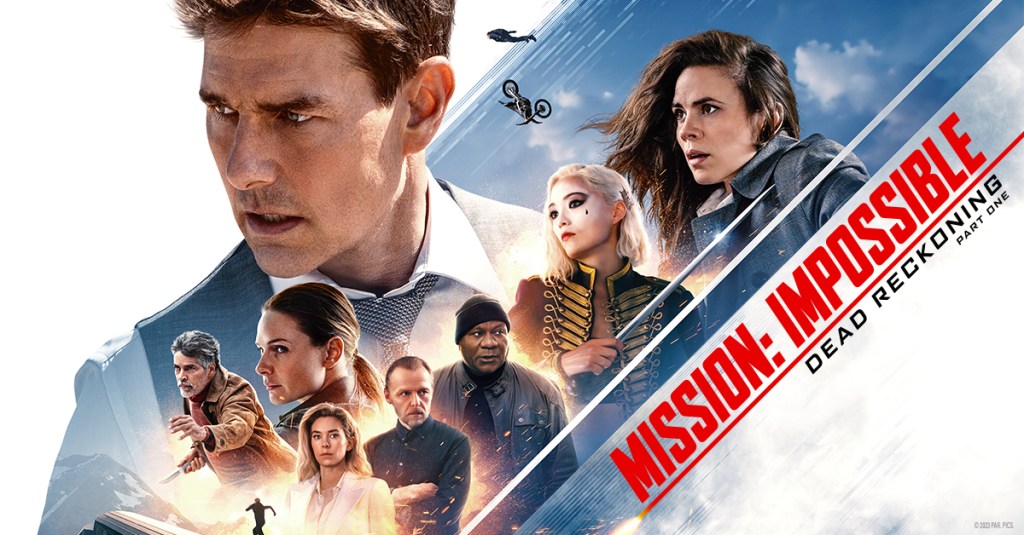
Mission Impossible is a registered trademark, one of the most important franchises in movie history. The adventures of that Ethan Hunt the eternal Tom Cruise, can be compared to those of the legendary James Bond. This saga was inspired by a television series that ran from the mid-60s to the early 70s that came to the big screen at the hands of Brian De Palma in 1996. That first installment is still one of the best movies in the franchise. Now comes Mission Impossible Dead Reckoning Part One, the seventh in a saga that has gained new life with the last three proposals.
The Mission Impossible universe has been built based on the canons of the action genre. It has evolved from the typical action film of the nineties to the most sophisticated, bombastic, and bombastic action thriller of the 21st century. Ethan Hunt has walked around the world kicking the butts of the most fearsome criminals, always under the noble cause of saving humanity. On more than one occasion he has been considered a renegade and even those on his own side have tried to eliminate him. In Mission Impossible Dead Reckoning Part One, once again agent Hunt faces an evil capable of ending life as we know it. An artificial intelligence system has become a threat and if it ends up in the wrong hands it would be a global catastrophe. Added to this we have an enigmatic character from Hunt’s past that further complicates the challenging mission.
The Mission Impossible Universe
As it has always been, it is the action that drives the story, the script by Christopher McQuarrie, Bruce Geller, and Erik Jendrensen is always at the service of each hand-to-hand fight, each chase, and each shooting. What lies behind it is a pretext to build characters who are always reacting to a certain situation, nothing more is required of them than to be convincing. McQuarrie has not only collaborated on the scripts for the last three films in the franchise but has also directed them. There are some details in the story that seem to be homages to that first movie that started it all. The chase through the alleys of Venice and the duel on a bridge reminds us of that opening sequence of the 1996 film. The fast-paced sequence on board the train reminds us of the first time we saw Ethan Hunt risk his life on the roof of a speeding train.
Mission Impossible Dead Reckoning Part One takes refuge in the clichés of the genre, but it is effective, finding a way to mock itself to remind the audience that what they are witnessing is pure entertainment spectacle. We know that the last-minute rescue will come, we know that the bomb will not explode, and the villain will not be able to shoot the girl in danger. Even though we anticipate the outcome when it arrives, it is still shocking. We must hold our breath, hold on tight to the seat and sigh when the adrenaline has already taken its toll. Mission Impossible offers a cinematic experience in its purest style, unpretentious and betting on a formula as old as cinema itself.
The Last Movie Star
His exploits have become the spearhead for promotional campaigns for his films. Cruise has turned to practices that seem anachronistic to move the public to movie theaters. He is the man who puts his head in the lion’s mouth to make sure the circus sells tickets; he is the pilot who jumps through the ring of fire in his motorcycle repeatedly to ensure the stands are always packed.
His acting talent is not in doubt, we have seen him at the service of directors like Stanley Kubrick in Eyes Wide Shut (1999) and Paul Thomas Anderson in Magnolia (1999), his range is impressive, and his on-screen magnetism is hard to match. With that force, he has maintained Mission Impossible for almost thirty years, navigating different eras, and appealing to different generations, but always finding a way to please and fill movie theaters. This saga is only one part of his legacy, but it is perhaps the most important for the cinema industry.
 The Last Movie Guy