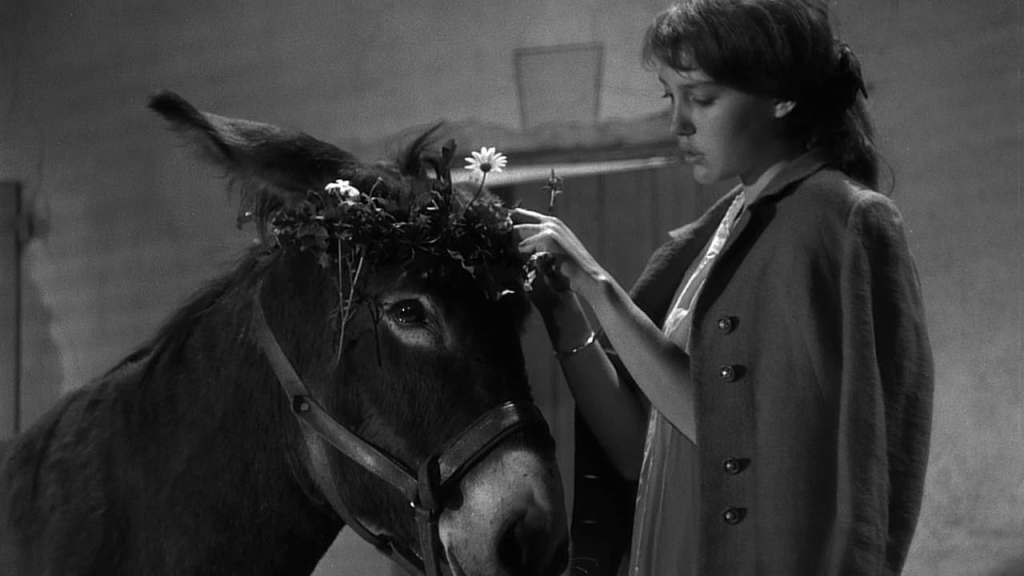
Legend has it that the inspiration came from The Idiot. But not just any idiot but the one that Dostoevsky gave birth to. Bresson found his muse reviewing the pages of the classic novel and especially that moment in which Prince Myshkin reflects on the braying of a donkey lying on the ground. From there was born what is today considered one of the masterpieces of cinema, Au Hasard Balthazar. For Robert Bresson, this would be his seventh feature film, as if fate had wanted to wink at the perfection of seven. Movies like A Man Escaped (1956) and Pickpocket (1959) had already put his name in the spotlight.
Balthazar’s path begins when Marie (Anne Wiazemsky), along with other children, finds him and baptizes him. It is not every day that a donkey is baptized, but that is how Bresson’s story begins. The children will grow up and Balthazar will go from owner to owner so that their misadventures serve as a pretext for the director to capture a story that speaks of life itself, of the essence of the human being. The parallelism between the lives of Marie and Balthazar divides Bresson’s speech into episodes that make us reflect on the seven deadly sins that affect the script to a greater or lesser extent.
Bresson uses as little as possible for the staging and avoids extensive dialogue. It shows us just the precise images in every frame and tells us only what is necessary. This is how he builds a compelling story that hits us with a major force in every sequence. From the affection and tenderness of children, Balthazar passes into the rough hands of adults, kindness, and cruelty take precedence, and the director’s speech is magnified. Fabulous performance by Anne Wiazemsky as Marie, it’s easy to connect with her and feel her suffering and pain as she transitions from childhood to adolescence. The juxtaposition between Marie and Balthazar is the pillar that helps the director to make the audience reflect on the deepest dilemmas of human existence.
Ghislain Cloquet’s (Love and Death, Tess) camera magnificently portrays Balthazar’s soul and Marie’s deepest feelings. The close-ups not only capture the expressions in a fabulous way, but they also allow us to see under the skin and connect on a deeper level with the characters. The editing by Raymond Lamy (a regular Bresson collaborator) is impressive and sets the narrative’s tone in keeping with the director’s style. With Lamy’s cuts, we have fantastic shots and reverse shots. The Bresson trademark is given to us with the close-up shots that show the hands acting and expressing more than the facial registers at certain moments.
Au Hasard Balthazar is a work that transcends time and mixes realism with poetry to give us a story exploring complex human nature issues. Bresson does it with his signature style that puts attention to detail first to craft a stunning visual aesthetic.
 The Last Movie Guy