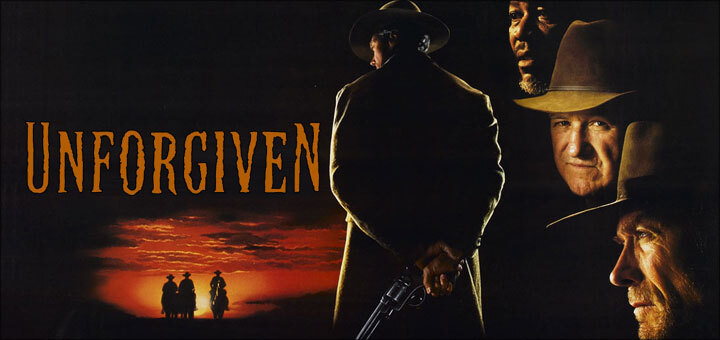
Western is perhaps the most cinematographic genre of all, it was born by and for the big screen. In the bowels of that far west of celluloid, the technique and codes that gave life to the seventh art were cultivated. In it, legends were forged in front of and behind the cameras that will prevail forever as unequivocal synonyms of cinema. Unforgiven (1992) is one of those legends, the film directed by Clint Eastwood came at a time when the genre was not at its best and brought it to life again.
Before Unforgiven we would have to go to 1976 and find the film The Shootist by director Don Siegel to come across a western that would dignify the genre. What Eastwood achieved was cinematic perfection from the script of David Webb Peoples who had worked on Blade Runner (1982). The visual power is combined with that dense script that goes slowly but sharply creating a tension that captivates the audience and forces them to feel every beat of these unforgettable characters. Jack N. Green’s camera gives us splendid cinematography that is foreshadowed by the film’s opening shot.
The film tells the story of William Munny, a former gunslinger, and outlaw who lives in decline in the Old West. Munny, an alcoholic widower, is forced to return to his past life when he is presented with the opportunity to collect a reward for the capture of two men who cut the face of a prostitute. Accompanied by his old partner Ned Logan and a young would-be cowboy named The Schofield Kid, Munny embarks on a journey to the town of Big Whiskey, where criminals are hiding out. As they move on, Munny confronts her own past violence and cruelty, questioning whether she has really left that old Munny behind.
William Munny, played by Clint Eastwood, is the cowboy demystified, in fact, the entire film is a demystification of the stereotypical western. Brilliant performance by Eastwood who is accompanied by Morgan Freeman as his faithful companion Ned Logan and Jaimz Woolvett in the character of the young and naive The Schofield Kid. On the other side stands Gene Hackman in the role of Little Bill, the heartless sheriff who becomes the perfect antagonist. Irony accentuates the fate of the protagonist, riding to the town of “Big Whiskey” seems like a death sentence for a man who was a victim of alcoholism. That physical journey becomes a metaphor for the spiritual journey that takes place in parallel.
It’s a big thing, killing a man. Take away everything he has and everything he will have.
With its Oscar for Best Picture Unforgiven, it became only the third Western to win the top Academy Award, the other two being Cimarron (1931) and Dances with Wolves (1990). Eastwood also took home the Best Director award, Hackman won Best Supporting Actor and Joel Cox won for his editing work. The film won the favor of the specialized press and conquered the audiences. The issues he raises in his speech have made the film one of the favorites of the public within Eastwood’s filmography.
Unforgiven does not glorify the genre, it demolishes paradigms and proposes a realistic approach drawing complex and morally ambiguous characters. Exploring themes such as redemption, violence, and justice, he builds a timeless story that grows over time.
 The Last Movie Guy